
It’s on our phones, desktops, and is integrated into operating systems, third-party apps, and hundreds of web-based applications. Cornerstone to modern communication, we even take it for granted, seldom asking for improvement. It stands between us and those we care about, and it’s obsolete.
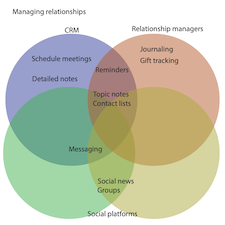
Enter the contacts application. Designed to store vital data about the people we interact with in our lives, it still resembles the analog rolodexes it once replaced, with simple functionality and interfaces. People can search for names, addresses and use it with email, calendar, and social apps — but it’s not enough.
Churn! Bang! CRASH! AI, RAG, and tens of new structures and applications have made the legacy apps seem slow and outdated. People want more, and fed by constantly evolving capabilities, and want it a lot faster. There’s every indication that people will move to an AI driven personal assistant, unless the contacts app evolves.
At this point you might ask why keep working on an evolving app, and not just start over. You could of course, at great expense. Yet a revitalized contacts application, enhanced with the features I will suggest, would become a cornerstone in any ecosystem, tempered by real world needs.
Looking Into It
Armed with a quiver of suspicions, I set to research, conducting informal interviews and polling online discussions. The research pointed to pain points I too have faced:
- People have trouble finding existing contacts (lack of information or tagging)
- Want to have more detail available (birthdays, gifts, relations, images, and more)
- Some wanted a free CRM
- Most wanted to customize categorization and sorting
- Contacts app take a lot of system resources, while not returning equivalent value
The twist in the research came when it became clear that people had low expectations with the application itself. Few people saw it as anything other than a digital rolodex, not expecting that it could be a relationships manager, a social partner, or a business asset.
Product Vision
The contacts application, usually nestled inside an OS or mobile platform, is reimagined on the front and back end to allow greater functionality and integration into the users’ lives.
Familiar and new features will be combined to create a new tool for users to not only access those they care about, but to foster better relationships. The new product would be built on a vector database of personal and common data, not only storing required contact information, but can be combined with new intelligence (AI, LLMs, advanced data retrieval) to allow for natural language queries, new suggestive features, and deeper search.
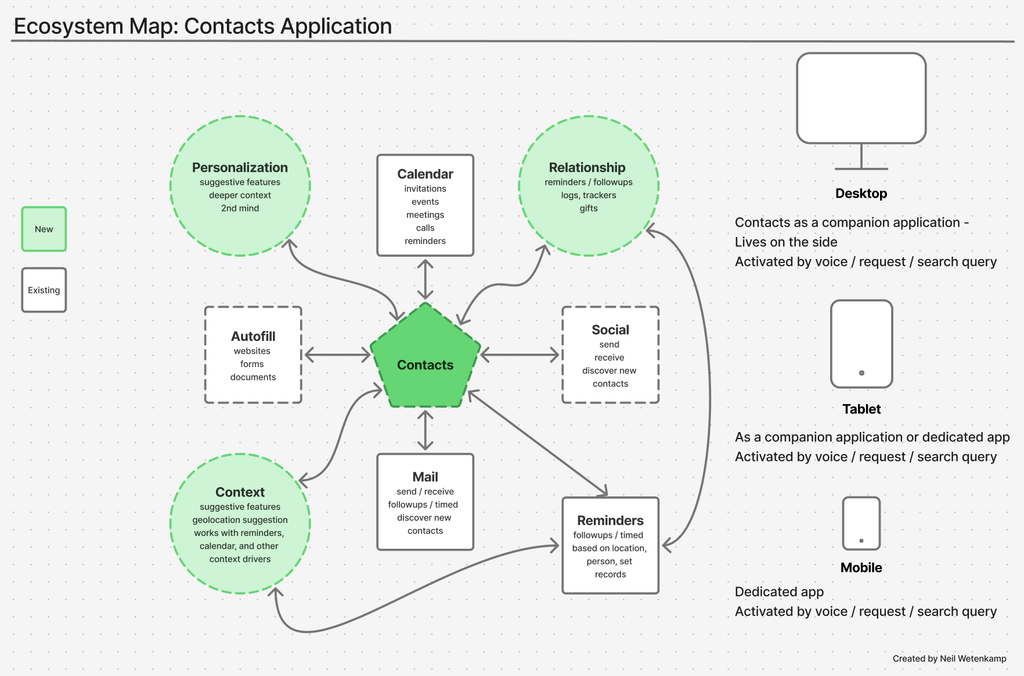
None of this would be revolutionary without a feature that is integral. Across the designs is contextual intelligence, added layers of information gathered across as many angles as possible, generated by both the user and devices. Locations, contexts, and other information would be embedded into entities that could be clustered in vectors, making all information deeply searchable and even predictive.
To get an understanding of contextual intelligence, imagine an ordinary trip to a cafe’.

The cafe’ – context 001 if you will – has layers of information that are easily indexed; addresses, names, hours, menu, social posts, time, date, business data, foot traffic, environmental data, as well as other contexts are all connected to it. Each person that comes to the cafe’ is equally a context as well, adding rich layers of information to the interaction.
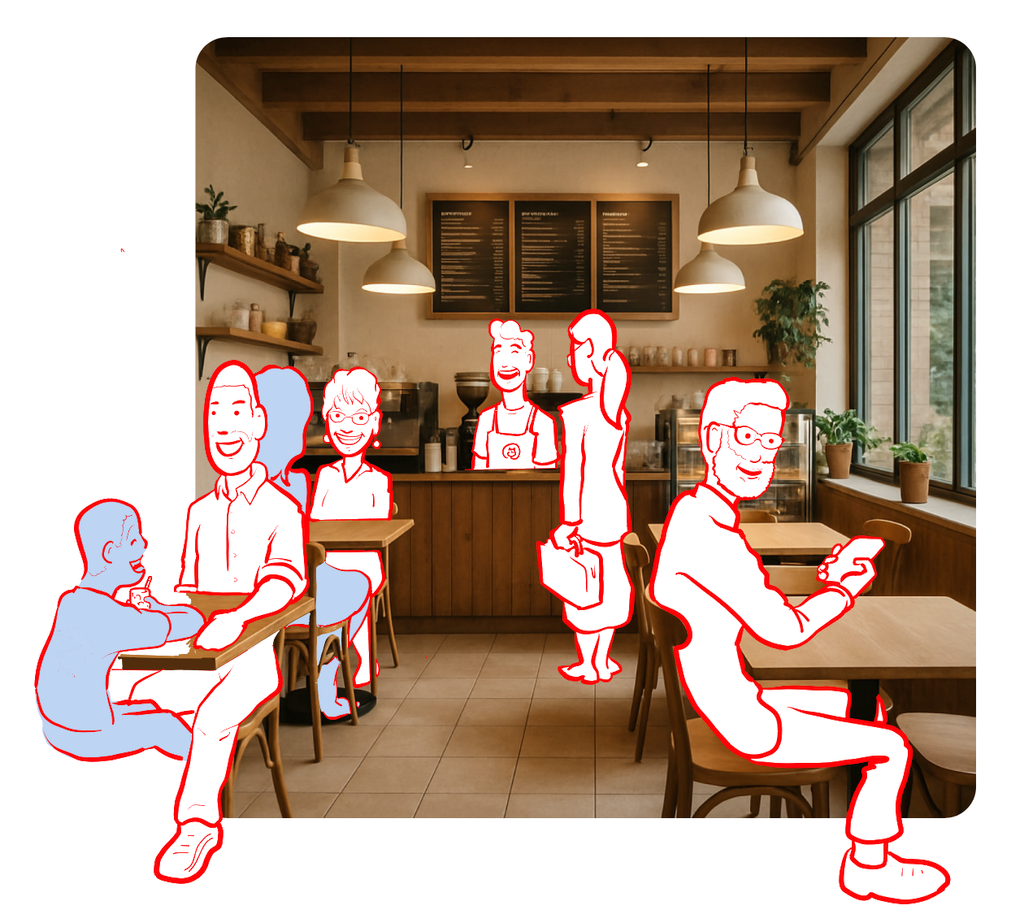
Isolating any one of those contexts would give you a chain of information points, and in a moment such as meeting a long lost contact or meeting someone new, contextual intelligence could encode entire experiences to moments or contact points. A query could tell you who it was you met at the cafe’, identify likely contacts on the barest of clues (i.e. “I think I had a mocha that day”), or even give you a clue of who might be working that day to track down a lead.
Furthermore it could offer guidance on places, people, gifts, and relationships through the connected contexts. In cooperation with other applications it could suggest meeting locations for upcoming events (complete with the preferences of all parties), initiate contact, or even find a nearby gift at a price point that matches the relationship of that person.
When a user finds that they are missing information a contextual intelligence could make all the difference as in the imagined medical scenario below,
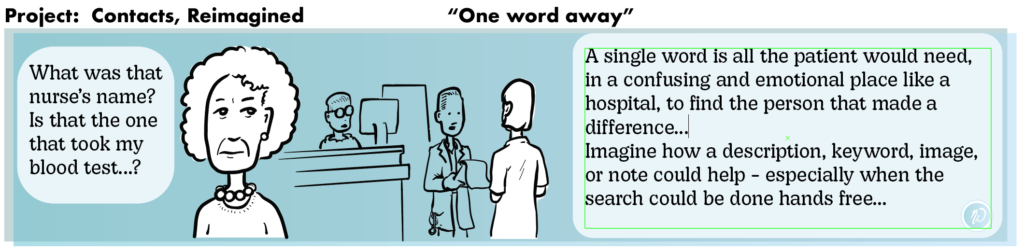
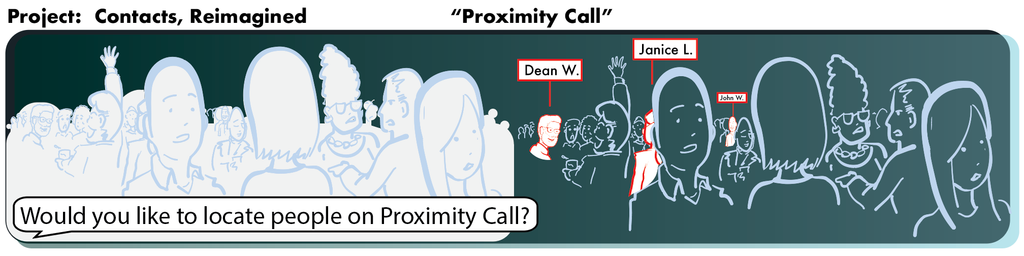
and could be utilized to build new contexts with willing users (see conference scenario below, with the “proximity call” feature).
Building the Vision
Building out the concept required wireframing new roles for the application, taking it beyond its role as a rolodex to something that could truly interact with context. For the purpose of the study I limited myself to conceptual prototyping in sketches, wireframes, and Figma lofi prototypes, knowing that the actual build would involve data structuring and integrations specific to where it would be deployed.
From sketches, wireframes, and lofi prototypes in Figma I drafted new roles for the application while preserving the familiar. It would take time, I reasoned, for users to see how powerful the new iteration could be. I cased the design in established list and card styles, all while adding in relationship features like contact frequency, timers, and social tools like gift records.
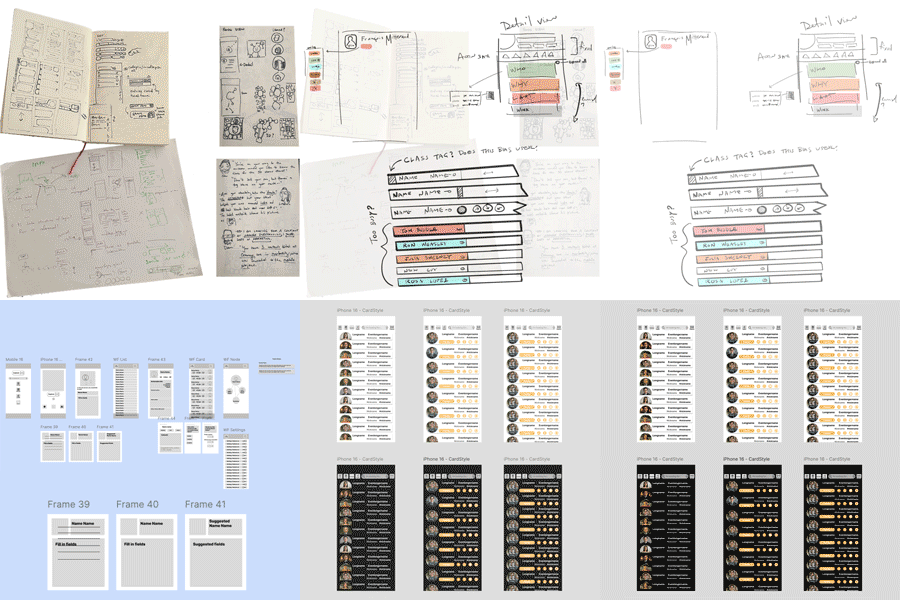
The objective was to create a starting point for an impressive feature list, and it was during the prototyping that I ran into my first hurdles.
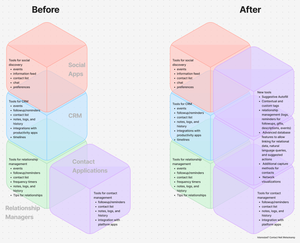
Thinking Past the Hurdles
Hurdle 1: Ambitious changes in function would require restructuring of data handling, and in the case of an OS, untangling data flows towards a centralized and secure database could fracture existing compatibilities. To address this I created data flow maps and acknowledged that more research would be needed to determine how information could be best labelled for maximum retrieval. Vector databases and RAG structures could help, but it became clear that how the information was first processed would have a large effect on the downstream retrieval.
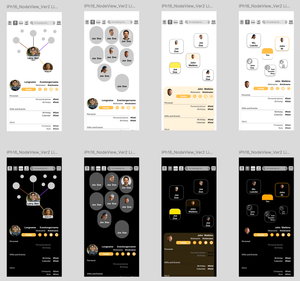
Hurdle 2: UI or open portal? The balance of showing information and being open to different types of uses would be an issue. Some users would want the guided flow of lists, others the relationship-oriented display, and others would want a VUI that allowed them to ask anything. For the prototype I kept it simple with interchangeable views; node mode for relationships, an enhanced list for visual search, and always present search and voice fields.
At the Time
At the time of this case study, companies like Apple, Google, OpenAI, Anthropic, and Meta were facing challenges from each other. Each was attempting to hone the ‘everything model,’ a universally useful system that would supplant all others. The nature of search and function are changing, and while the frontier companies are improving intelligence, applications like the contacts app are largely ignored. The trend of compute-before-user has been continuing, undoubtedly fueled by the uncertain success of intelligence.
I would argue that whoever can create a platform that rises above, will most likely do it by following first principles to better the user’s lives, and do very well. Bettering people’s lives by bringing them closer — the function of the contacts application — is what this concept proposes, and is high ROI indeed.
Leave a Reply